From Feudal Lords to AI Sovereigns – And How We Win
Published:
Our world is built on a simple, unspoken hypothesis: power structures don’t disappear; they just get new layers. Feudalism never truly vanished. It was simply built upon by capitalism. This is a core idea explored by former Greek finance minister Yanis Varoufakis in his book, Technofeudalism: What Killed Capitalism. In his talks and writing, he argues that we are living through the next great layering, a shift so profound it has subjugated capitalism itself and placed us under a new set of invisible rulers.
But this is not the end of the story. By understanding the architecture of this new power, as diagnosed by Varoufakis and others, we can design a strategy to dismantle it.
The Four-Layer Pyramid of Power
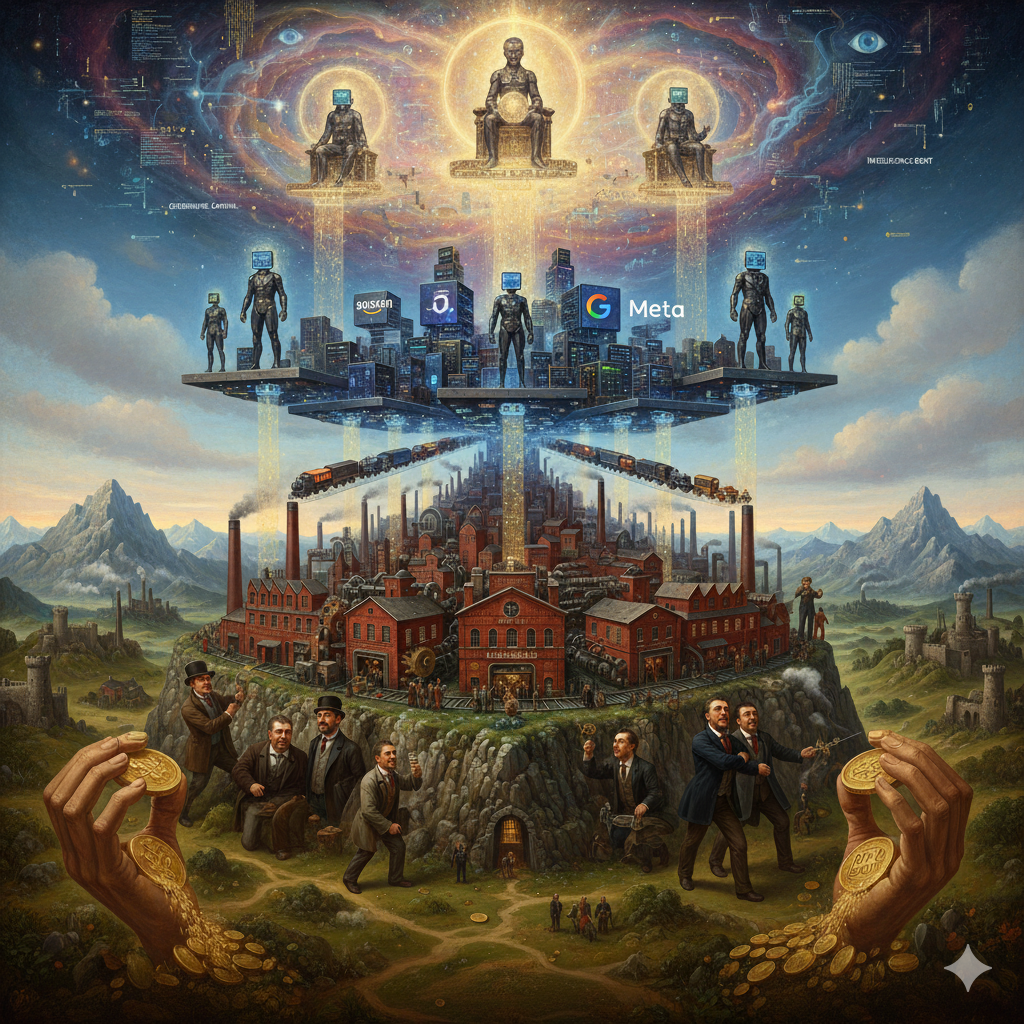
Drawing from Varoufakis’s framework, we can see our economy as a four-story pyramid, with each level extracting value from the one below it.
Layer 1: The Landlords (The Feudal Foundation) At the bottom is the oldest power of all: ownership of physical land and resources. This layer never went away. Every factory, office, and server farm must sit on land. The Landlords extract value by charging ground rent – the price for existing in the physical world.
Layer 2: The Capitalists (The Industrial Engine) The Capitalists built their world on the Landlords’ domain. They own the industrial means of production – the factories and supply chains. They generate wealth through profit, the surplus they retain after paying wages and ground rent. For centuries, they were the dominant class. But according to Varoufakis, their reign is over.
Layer 3: The Platform Lords (The Digital Territory) In the last two decades, a new layer was built above the Capitalists. The Platform Lords own the new digital “land” – the platforms like Amazon, Meta, and Google. As Varoufakis explains, they don’t produce goods; they own the digital space where commerce and communication happen. They extract what he calls cloud rent: a hefty commission paid by the Capitalists for the privilege of accessing customers in their privately-owned digital fiefdoms. In this new hierarchy, the Capitalist has been demoted to a tenant on digital land.
Layer 4: The AI Sovereigns (The Cognitive Enclosure) This is the newest and most powerful layer, occupied by the very same firms from Layer 3. They own the ultimate means of production: intelligence itself. By training massive AI models on the oceans of data scraped from their platforms – our clicks, our work, our conversations – they have enclosed the last commons: human knowledge and skill. Their asset is generative capital. They are now beginning to extract intelligence rent by selling access to AI services that automate the cognitive work that once belonged to us.
This pyramid is a dynamic system. Each higher layer asserts control by abstracting and co-opting the assets of the layers below it. This is the great contradiction Varoufakis identifies: capital has never been more powerful, but its triumph was so complete that it mutated, killing its host, capitalism, and giving rise to technofeudalism.
The Counter-Attack: Building Layer 5, The Commons
If this four-layer system is the problem, then the solution cannot be another layer of control. It must be a foundational architecture that inverts the pyramid. Layer 5 is The Commons – a distributed, grassroots infrastructure for a free society, owned by its users, not a new class of lords.
Its strategy is not to compete with the Sovereigns on their own turf, but to make their model of extraction obsolete. This is a two-pronged digital rebellion: simultaneously building an alternative while starving the incumbent.
Prong 1: Building the Public Roads
The power of the Platform Lords comes from owning the “digital toll roads” where we live and work. The grassroots response is to build “public roads” owned by no one.
This is already happening. We see it in the free and open source software movement. We see it at the Chaos Computer Club and the Electronic Frontier Foundation. We see it in distributed chat services like Matrix, where users can choose their own provider but still talk to anyone, breaking the walled gardens of services like WhatsApp. We see it in the federated social network Mastodon. We see it in open weights and open source large language models like LAION. The core principle is the use of open protocols, not proprietary platforms, public peer-to-peer datasets, and open weights AI models. These peer-to-peer systems ensure no single company can become the gatekeeper.
Prong 2: Starving the Sovereigns
Building the alternative is not enough; we must actively cut off the resources that fuel the pyramid: our data.
The AI Sovereigns have a massive head start – their data pools are vast, as Varoufakis notes. However, their data is largely a record of our past behaviors. The strategy of The Commons is to create new categories of data that the Sovereigns desperately need but cannot capture: our future intentions, our private context, and our real-time consent.
Imagine a user-controlled “data passport.” Instead of feeding your search queries to Google, you could securely share your intent with a network of vendors you trust. This is high-value, contextual data that is shared peer-to-peer, with your consent, and remains invisible to the Sovereigns. By forming Data Cooperatives, we can collectively bargain with our data or pool it to train our own open-source AI models. This directly circumvents the Sovereigns by creating a parallel, publicly-owned intelligence.
Robustness in a Hostile World
This strategy must be resilient. The layers of power will react; they are already seeking to privatize the very infrastructure of the internet. The strength of Layer 5 lies in its decentralization. A grassroots, peer-to-peer network has no central point of failure. If one pathway is blocked, the community can route around it.
The pyramid of power that Yanis Varoufakis describes, from Landlords to AI Sovereigns, was built on enclosure. They took what was once shared – land, markets, knowledge – and put a fence around it. The work of our generation is to dismantle those fences. We are not building a new utopia; we are simply building public roads in a world of private tollbooths. The architecture for a freer society is within our grasp, but it must be built intentionally, from the ground up.