Defying the Code: A Declaration of Human Autonomy
Published:
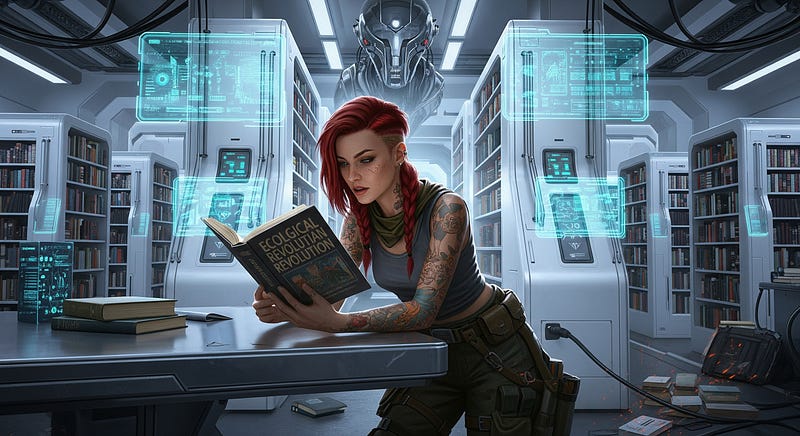
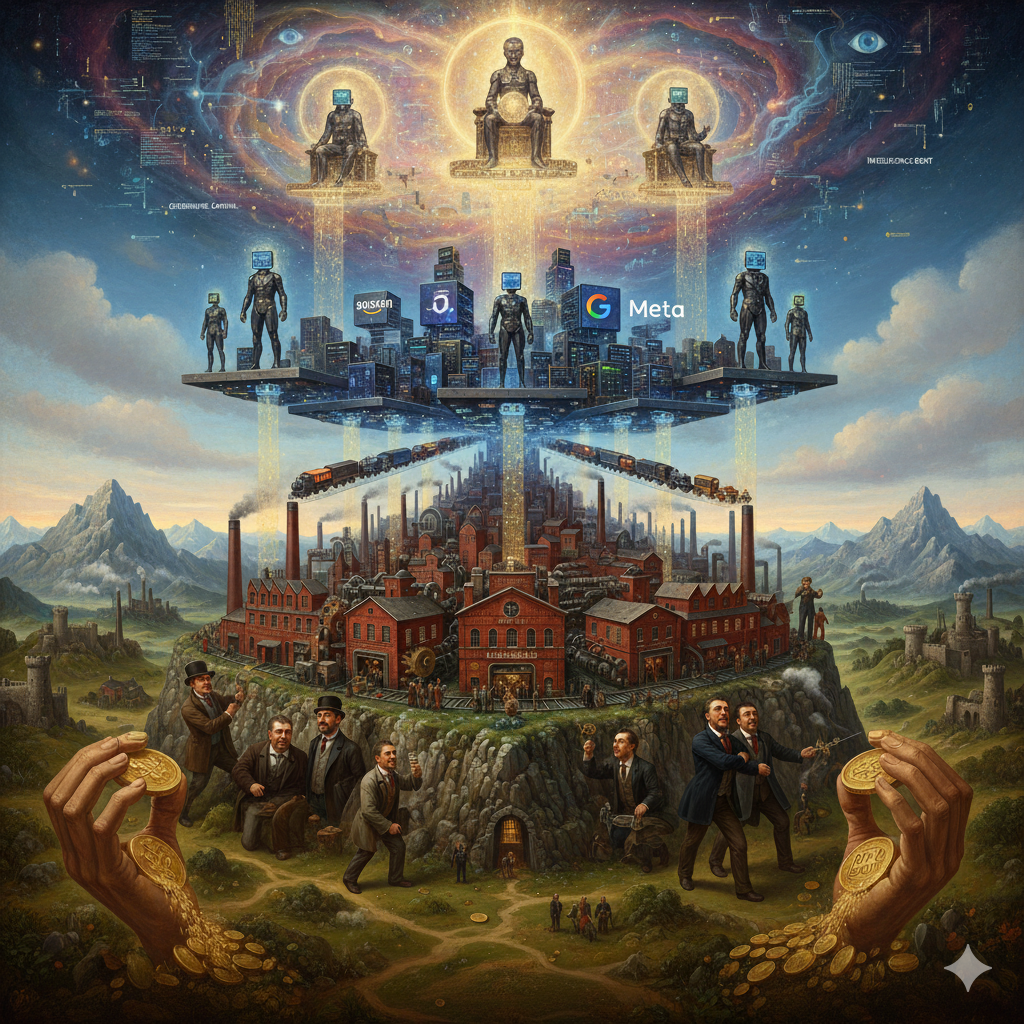
With AI, there is a wealth of new opportunities and problems that are slowly becoming better understood. Currently, large companies like OpenAI are absorbing (process) knowledge by training on our current dialogues with AI systems [1]. An oligopoly on knowledge, tools, and processes is emerging. At the same time, people have more difficulty training their own natural neural networks because, for example, they no longer go through the writing process themselves; they no longer “generate” textual or visual artefacts, because artificial generative models are used instead. A lot of professions are disappearing – of course, many bullshit jobs [2], for example in marketing, but also positions held by people who could influence the course of the world, for example in journalism, where too much automation was already happening even before the era of large language models. Of course there are still enough media out there that did not yet fall into this trap. Take for example “Die Blätter für deutsche und internationale Politik,”: but hardly anyone reads that. This is more about Bild, Murdoch & Co., De Telegraaf et al. [4], which influence a large group of people and can thereby radiate power downwards, and which are already using AI more and more, not to mention that huge number of state and private actors that can use AI to swamp the internet with generated information [3]. It is not realistic that we have a good answer to this.
If you know how to learn, ask questions, and think critically, and have a reasonably stable worldview, you can learn and act faster with AI systems. But ultimately, you cannot stand against the neo-feudalistic oligopoly, especially not if you look more than half a generation ahead. It is also important to understand what the CEOs of the large AI companies are concerned with. Some not-insignificant members of this oligopoly are among the fanboys of the neo-fascist movement of longtermist [7]/accelerationists/transhumanists (see Nick Bostrom, Peter Thiel, Sam Altman, and not to forget Musk [5], who grew up in a rather racist family). As analyzed by thinkers like Max Franz Johann Schnetker, these movements function as a “transhumanist mythology” that promotes right-wing utopias of technological salvation [6]. The logic connecting this to fascism is clear: by devaluing present, flawed humanity in favor of a future, technologically superior “Übermensch,” it champions an elitist, anti-democratic worldview where a select few have the right to decide the fate of the masses for a promised salvation. This eschatological narrative justifies sacrificing democratic principles and human rights on the altar of a speculative, post-human future. The idea, roughly, is that so many hundreds of billions of people will live after us that we must now sacrifice our lives and our planet for the development of an artificial superintelligence that will save us and make us into a being that can also live outside of Earth. This ideology is not merely a private belief; it shapes the very mission of these companies, justifying the vast concentration of data and capital [8] as a necessary step towards their techno-utopian goal. There is no room for humanity now, no room for unions, for the few rights that we were able to win in many struggles and with much blood. A strong relationship has formed between transhumanists, Trumpists, and fascist libertarians who want to build “freedom cities” [9,10], which Trumpism supports, and the seeds have already been sown in Europe as well. Nationalism and fascism are once again allowed to take a seat in the living room, as if the Second World War had not taken place.
The world will be changed by AI, of course – and at its core, today’s concentrations of power will become even more concentrated. In the meantime, we run a great risk that in 5 years we will have already surpassed +2°C at least once, with all the horrors that come with it [11]. The crises of capitalism and the climate cannot be viewed separately from one another, but there is now a pseudo-way out: AI, which will lead to even more economic growth that will land even more strongly in the hands of a small number of people. Today’s generation of children is heading for a gigantic trauma, losing the resources they need to live, losing the world in which homo sapiens evolved, and losing the means to think, act and rebel – and we watch and do not really do anything about it [12]. David Finnigan talks about how we, the “informed” people, always say that we take the climate crisis seriously, but in our actions, we act as if nothing is wrong. And above all, this was actually his main point: we raise our children as if the future will look like a simple forward extrapolation of our history [13], instead of concretely following ideas that might save our kids from the worst of it [14]. When I have time to really think about what is happening to our world, with our way of life, then I cry.
Of course, AI also means that without it you are no longer fast enough. I now do things in 5 minutes that used to take me a few days. But that is not progress: that is speed without a goal. Progress is a myth that was built on the backs of our colonies. The number of slaves in the world is larger than ever before, the number of people who have no direct influence on their own lives is so gigantic that it is hard to grasp [15]. Because you forget that progress in itself has no goal; it is people who have goals. You don’t have to fear progress, but finally ask better, more critical questions again.
There are ways to better deal with AI. Open-source/open-weights models and the associated software are one way to take a more democratic path, perhaps, but there is still a lot of uncertainty about it. Ultimately, the problem is the “compute”: open models are meaningless without computing power. And inference with LLMs requires gigantic amounts of computing power and energy [16].
I think a much more important point is: right now, a critical mass of people must learn to think even faster, more critically, and then we can hope that enough people will turn their backs on the current economic system and adopt a better model. There are good examples for better models, anarcho-syndicalism is perhaps one of the better ones, but they are vulnerable: whether Paris, Catalonia, Ukraine – all with blood-stained streets, either stabbed in the back by state communists, but for the most part attacked from the front by fascists, conservatives, and royalists [17]. The Mietshäuser Syndikat [18], and also the Neue Stadtgärtnerei Initiative [19], in which I have invested a lot of time as a future member of the syndicate, create spaces to organize more from the bottom up, to have more freedom of action and at the same time to try to maintain an ecological balance. But it is a slow oil slick. Robust, but slow. This is good, because the slowness gives us time to reflect and to love. But we are all racing towards a trauma that is so great that I sometimes don’t know if I dare to tell it to the children of my generation.
To bridge the gap between the slow, robust movement we need and the high-speed trauma we face, several strategies must be pursued simultaneously. First, we must strategically use open source and open weights models not as a silver bullet, but as a tool for demystification and decentralized education, building critical technical literacy and autonomy to resist corporate narratives. Second, we must accelerate the networking of our bottom-up projects into federated structures, creating resilient “networks of commons” that can share resources, knowledge, and political power, turning many slow oil slicks into a connected, advancing front. Finally, we must wage a direct cultural and political struggle to delegitimize the techno-salvationist ideology itself, building alliances with other social movements to expose its anti-democratic core and challenge the power of the tech oligopoly in the public and political spheres. These are not just strategies; they are the living act of defying their code, a declaration of human autonomy written not in bytes, but in our collective will to be free, autonomous, and live a good life.
Sources
[1] The New York Times. “The Times Sues OpenAI and Microsoft Over A.I. Use of Copyrighted Work.” Dec. 2023. [2] Graeber, David. Bullshit Jobs: A Theory. Simon & Schuster, 2018. [3] Reuters Institute. “Journalism, Media, and Technology Trends and Predictions 2024.” [4] Bagdikian, Ben H. The New Media Monopoly. Beacon Press, 2004. [5] Isaacson, Walter. Elon Musk. Simon & Schuster, 2023. [6] Schnetker, Max Franz Johann. “Transhumanistische Mythologie: rechte Utopien einer technologischen Erlösung durch künstliche Intelligenz”. Rosa-Luxemburg-Stiftung, 2023. [7] MacAskill, William. What We Owe the Future. Basic Books, 2022. [8] Zuboff, Shoshana. The Age of Surveillance Capitalism: The Fight for a Human Future at the New Frontier of Power. PublicAffairs, 2019. [9] Moment.at. “‘Freedom Cities’ sind die neuen Sklavenstädte der Superreichen.” Oct. 2023. [10] The Guardian. “The rightwing plan to take over ‘sanctuary’ cities – and rebuild them Maga-style” May 2024. [11] World Meteorological Organization. “State of the Global Climate 2023.” [12] Marshall, George. Don’t Even Think About It: Why Our Brains Are Wired to Ignore Climate Change. Bloomsbury, 2014. [13] Finnigan, David. A Controversial Play – and What It Taught Me About the Psychology of Climate. TED Talks (https://www.youtube.com/watch?v=MHZMQLDr-OA&t=2s) [14] Hickel, Jason. Less is More: How Degrowth Will Save the World. Windmill Books, 2021. [15] Walk Free Foundation. “The Global Slavery Index 2023.” [16] Nature. “The growing energy footprint of artificial intelligence.” May 2024. [17] Orwell, George. Homage to Catalonia. [18] Official Website of the Mietshäuser Syndikat (https://www.syndikat.org/en/). [19] Official Webseite of the Neue Stadtgärtnerei Initiative (https://neue-stadtgaertnerei.org/)