Spiegelmaschine
Generative Art AI Co-creativity
Spiegelmaschine
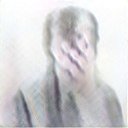
Mirror machine. A generative art system trained on approximately 1000 paintings by Bonn-based artist Steffen Terk, capable of producing an endless stream of new images in his visual language.
The project is a direct application of research on machine learning and co-creativity — specifically the question of how generative models can extend a human artist’s practice rather than replace it. The model learned color relationships, compositional tendencies, and painterly texture from Steffen’s body of work, and now generates variations that sit somewhere between memory and imagination.
Spiegelmaschine has its own online presence and posts generated images regularly.
Why this project matters
Co-creativity is the thread running through my research. Whether it’s an engineer exploring a design space, an urban planner navigating climate constraints, or an artist extending their own visual vocabulary — the best computational tools do not automate the human out of the process. They make the space of possibilities legible, navigable, and surprising.
Spiegelmaschine makes this concrete: the artist remains the author of the aesthetic world; the machine is its restless inhabitant.
Technical notes
Built using a Generative Adversarial Network (GAN) trained on a curated dataset of approximately 1000 high-resolution photographs of Steffen Terk’s paintings. The model is not fine-tuned from a general foundation model — it was trained from a style-specific dataset to preserve the idiosyncrasies of an individual hand.
Try the interactive toy
The Spiegelmaschine post includes a small, self-contained generative-art toy — a seeded kaleidoscope inspired by the project. Adjust the symmetry, complexity, seed, and palette to explore the machine’s visual language.