
CytoTransport
DFG Funded Biology In-silico Modeling Open Source
Mechanisms and Modulation of Cellular Transport Processes
The CytoTransport research cluster combines expertise in biomedicine, computational modeling, structural biology, chemistry, and materials science to investigate how cells move molecules across membranes — processes that are central to diseases like hypertension and Liddle’s syndrome.
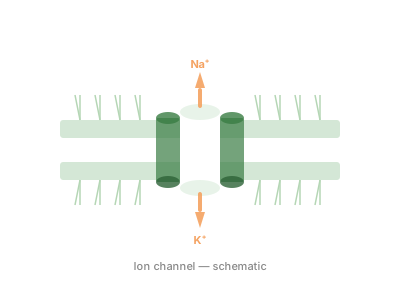
My role is in the in-silico modeling and new methods development field — building computational models and machine learning surrogates that reduce the cost of understanding molecular mechanisms using approaches developed in the deep learning and quality diversity optimization domains, predicting effects of mutations, and predicting molecular structural conformations.
Fields of research
- Cellular Transport Mechanisms — ion channels, transport proteins, intracellular signaling
- Bio-inspired Nanomaterials — synthetic membrane technologies for modulating transport
- In-silico Modeling — molecular dynamics surrogates, parameter optimization, structural prediction
Current work
- Virtual screening — computational screening of compound libraries against target transport proteins to identify promising drug candidates
- Variant effect prediction for ENaC — predicting how genetic variants in the Epithelial Sodium Channel affect function, relevant to hypertension and Liddle’s syndrome
- Molecular conformation generation and prediction — generating and scoring low-energy 3D molecular geometries using ML models
- Force field parameterization — developing optimized force field parameters for molecular dynamics simulations using surrogate-assisted optimization
Partners
9 working groups from H-BRS research institutes IFGA (Institute for Functional Gene Analytics) and TREE (Institute for Technology, Resource and Energy-efficient Engineering), funded by the Deutsche Forschungsgemeinschaft (DFG).
Selected publications
- Fine-tuning property domain weighting factors and the objective function in force field parameter optimization (2025)
- Speed up Multi-Scale Force Field Parameter Optimization by Substituting Molecular Dynamics Calculations with a Machine Learning Surrogate Model (2025)
- Determining Lennard-Jones Parameters Using Multiscale Target Data through Presampling Enhanced Surrogate Assisted Global Optimization (2023)
- Open-source machine learning in computational chemistry (2023)
CytoTransport project page at H-BRS
Open science
All methods and models developed in CytoTransport are published open source. I believe strongly in open-source code, open data, and open model weights as preconditions for reproducible and trustworthy science.